
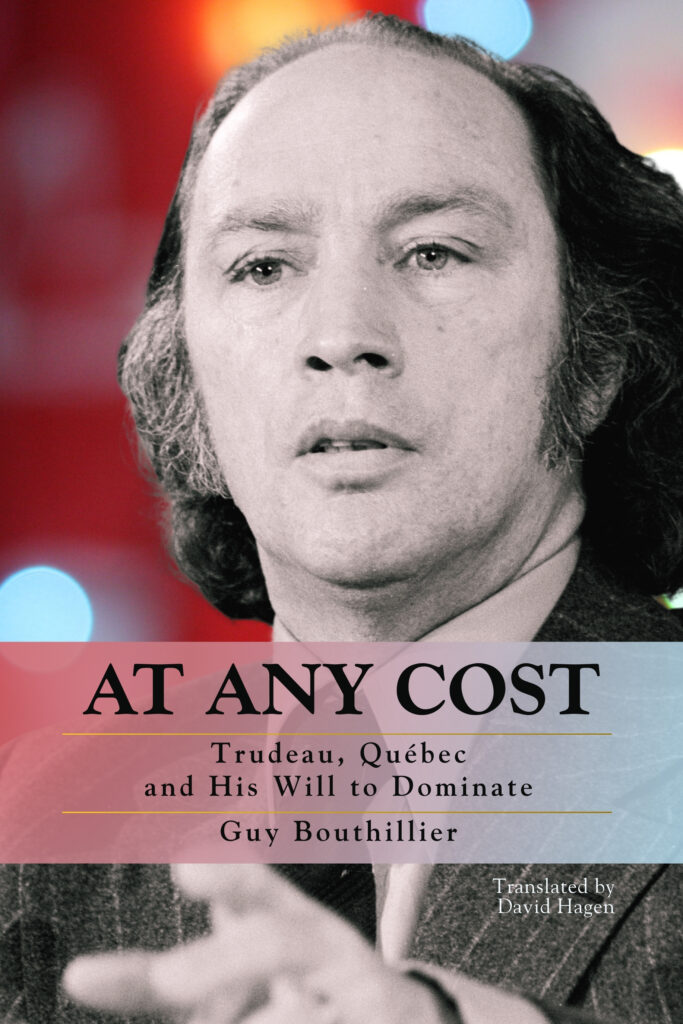
AT ANY COST
TRUDEAU, QUÉBEC AND HIS WILL TO DOMINATE.
By Guy Bouthillier, translated by David Hagen
Author Guy Bouthillier answers some questions about his upcoming book about Pierre Elliot Trudeau.
BARAKA Why do you think it’s important that the next generation of young people know about Pierre Elliot Trudeau?
BOUTHILLIER Trudeau may have dominated politics in Canada for many years, but his legacy is two-dimensional. This book is written for younger readers, who will find a man full of contradictions.
He is remembered as a champion of fundamental freedoms, yet his best-known feat was to abolish them with the War Measures in 1970. This proud “citizen of the world” abandoned his fellow French Canadians who he felt were too weak. Though Trudeau was a good Jesuit and fully aware that in politics you must treat opponents fairly, he constantly insulted and slandered those who dared disagree.
While he became the ultimate symbol of federalism, few know that as a student he was among the most active separatists. Inspired by Patriotes and Reformers in Upper and Lower Canada in 1837-38, Trudeau drafted a constitution for Quebec to leave Canada. At the same time, he set out to create a clandestine armed society that could sabotage railways and paralyze public services. His subsequent about face requires explanation.
BARAKA “At any cost?” was the question journalist Tim Ralfe asked Trudeau on October 13, 1970, three days before he proclaimed the War Measures. His answer was the now famous “Just watch me.” How did Trudeau’s past from the 1930s until 1970 influence the man who would go on to take such authoritarian and military measures?
BOUTHILLIER His only goal was to be at the helm of political power and be among the powerful people in the world. Ideology had nothing to do with it. Behind his smile and dapper dress, Trudeau was obsessed with getting the last word and dominating the room. As a young man, he never shied away from a fight, be it with words, fists, or brow beatings. To prepare himself, he boxed, did judo and hunted with a crossbow. He would resort to surprise attacks just to test himself. Victims could be a man walking by, a stranger in a tramway, or a fellow student. He loved to scare people and to humiliate his opponent.
Talk of war in Europe aroused his political interest. On a family trip in 1933, he proudly admired Mussolini haranguing crowds in Rome. In Germany, Hitler’s soldiers on motorcycles so impressed him that he wrote emotionally about it in his memoirs half a century later. He avidly read about people known for political violence, such as Robespierre or Lenin. He was fascinated by pro-German collaborators and anti-Semites like Pétain in France, Degrelle in Belgium, and Codréanu in Romania. Unsurprisingly, he told his girlfriend at the time that he dreamed of “revolution, blood and dynamite.”
BARAKA How does Trudeau compare to other prime ministers in the history of Canada?
BOUTHILLIER The definitive statement about Trudeau has yet to be written. A leading magazine asked Canadian historians where Trudeau placed among prime ministers since 1867. They granted him a modest fifth place. One historian said he was “the disappointment of the century.” On the other hand, his main biographer said that without him, Quebec would be an independent country today.
What do the people think? His name was put on Montreal’s international airport. In the West however, citizens mobilized to block Ottawa from renaming the highest mountain in Canada from Mount McKinley to Mount Trudeau. So support is far from unanimous.


Facebook