
AT ANY COST
TRUDEAU, QUÉBEC AND HIS WILL TO DOMINATE.
By Guy Bouthillier, translated by David Hagen
Author Guy Bouthillier answers questions.
Based on your research for AT ANY COST, what is important for young people who don’t know Pierre-Elliott Trudeau to know about him?
Trudeau dominated politics in Canada for many years but we don’t hear much about him these days. You have to be fifty to have known him. This book is written for younger readers, who will find a man full of contradictions.
He is said have championed fundamental freedoms, yet the best-known feat was to abolish them with the War Measures in 1970. This proud “citizen of the world,” abandoned his fellow French Canadians who were too weak for him. Though Trudeau was a good Catholic fully aware that in politics you must treat opponents fairly and not accuse falsely them of supporting a particular ideology, he constantly insulted and slandered people who dared disagree.
He became the federalists’ maximum leader, but few know that as a student he was among the most active separatists. Inspired by Patriotes and Reformers in Upper and Lower Canada in 1837-38, he drafted a constitution for Quebec to leave Canada. At the same time, he sed out to create a clandestine armed society that could sabotage railways and paralyse public services. This about face requires explanation.
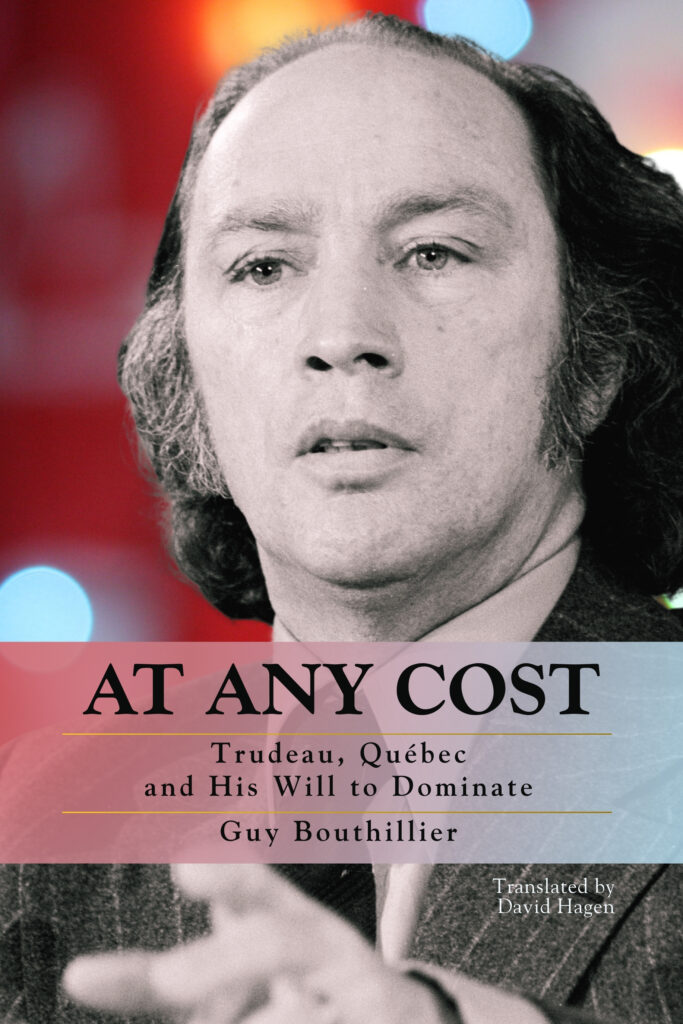
AT ANY COST? is the question journalist Tim Ralfe asked Trudeau on October 13, 1970, three days before he proclaimed the War Measures. His answer was “JUST WATCH ME!”
How did Trudeau’s past from the 1930s until 1970 influence the man who took such authoritarian and military measures?
Ideology has nothing to do with it. His only goal was be at the helm of political power and be among the powerful people in the world. Behind his smile and dapper dress, Trudeau was obsessed about being Number 1, getting the last word, and dominating. He never shied away from a fight, be it with words or, more often, fists or brow beatings. To prepare himself physically, he boxed, did judo and hunted with a crossbow. He would resort to surprise attacks just to test himself. Victims could be a man walking by, a stranger in a tramway, or a fellow student. He loved to scare people and to humiliate his opponent.
Talk of war in Europe aroused his interest. On a family trip in 1933, he proudly admired Mussolini haranguing crowds in Rome. In Germany, Hitler’s soldiers on motorcycles so impressed him that he wrote emotionally about it in his Memoirs half a century later. Back in Montreal, he avidly read about people known for political violence, such as Robespierre or Lenin. He was fascinated by pro-German collaborators and anti-Semites like Pétain in France, Degrelle in Belgium, and Codréanu in Romania. Unsurprisingly, he told his girlfriend that he dreamed of “revolution, blood and dynamite.”
How does Trudeau compare to other prime ministers in the history of Canada.
The definitive statement about Trudeau has yet to be written. A leading magazine asked Canadian historians where Trudeau placed among the prime ministers since 1867. They granted him a modest fifth place. One historian said he was “the disappointment of the century.” On the other hand, his main biographer said that without him, Quebec would be an independent country today. What do the people think? His name was put on Montreal’s international airport. In the West however, citizens mobilized to prevent Ottawa from renaming the highest mountain in Canada, Mount McKinley. So support is far from unanimous.


Facebook